| | The Families of Angiosperms |
Habit and leaf form. Trees and shrubs (with ‘equisetiform’ shoots, having primary assimilatory branches whorled on larger branches which are themselves whorled on still more mature shoots). Switch-plants; with the principal photosynthesizing function transferred to stems. Leaves much reduced. Leptocaul. Helophytic to xerophytic. Leaves minute (having been interpreted as the tips of leaves congenitally fused to the stems and represented by the characteristic ribs of the latter - see illustration); whorled; 4–12 per whorl; membranous; sessile; connate; aromatic (or the shoots so, in Allocasuarina), or without marked odour; simple; exstipulate.
Leaf anatomy. Minor leaf veins without phloem transfer cells.
Axial (stem, wood) anatomy. Cork cambium present. Nodes unilacunar. Primary vascular tissues comprising two or more rings of bundles (comprising an outer ring of vascular bundles iterpretable as leaf traces that in some species alternate with a ring of cauline vascular bundles, or in others lie outside a continuous cauline vascular ring: see illustration); collateral. Internal phloem absent. Cortical bundles present (if the outer ring be so interpreted). Secondary thickening developing from a conventional cambial ring.
The wood diffuse porous. The vessels small to medium. The vessel end-walls scalariform, or scalariform and simple. The vessels without vestured pits; with spiral thickening, or without spiral thickening. The axial xylem with tracheids; with vasicentric tracheids (commonly), or without vasicentric tracheids; with fibre tracheids; without septate fibres. The fibres without spiral thickening. ‘Included’ phloem absent. The wood not storied.
Reproductive type, pollination. Unisexual flowers present. Plants monoecious, or dioecious. Pollination anemophilous.
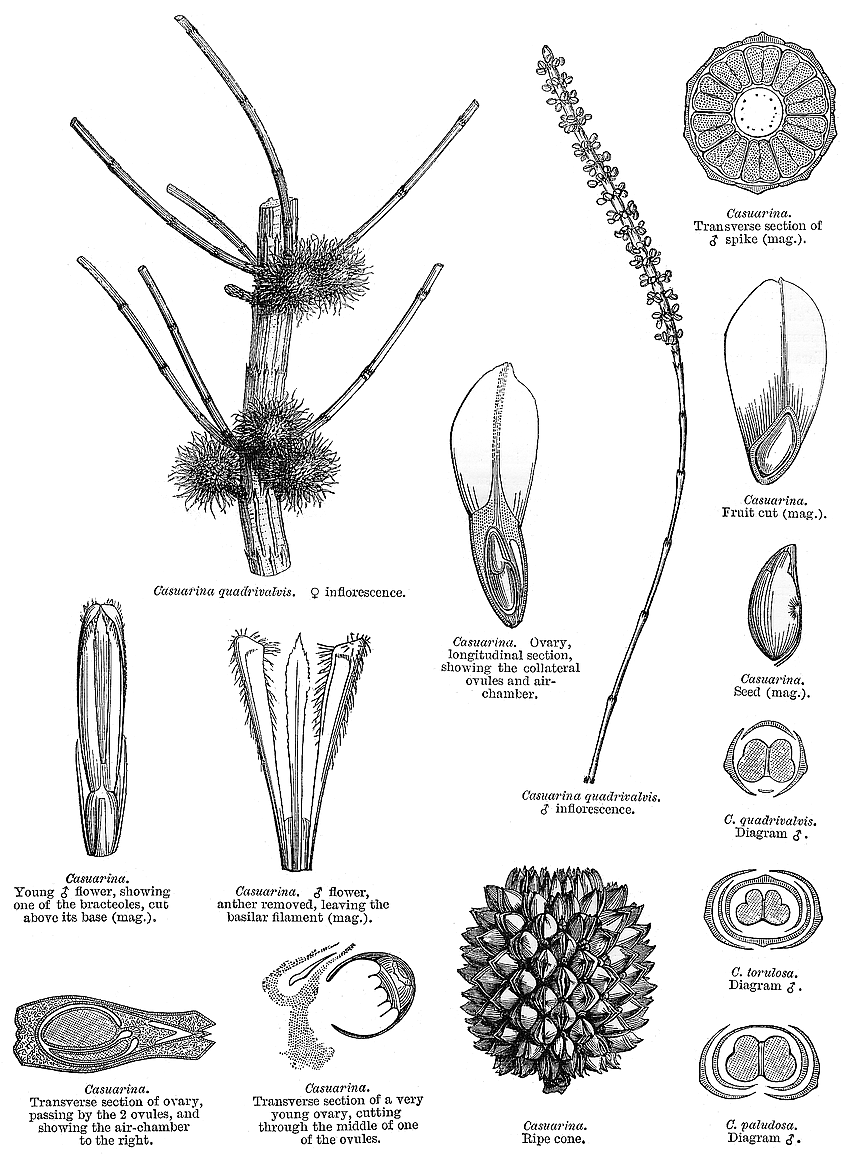
Inflorescence, floral, fruit and seed morphology. Flowers aggregated in ‘inflorescences’; in spikes, in heads, in glomerules, and in catkins. The fruiting inflorescences conelike. Inflorescences catkins, with males in simple or compound spikes, females in spherical or ovoid heads maturing into woody ‘cones’. Flowers bracteate (the bracts becoming woody in the female); bracteolate (the bracteoles becoming woody in the female); small. Hypogynous disk absent.
Perianth vestigial (male flowers), or absent (females); when present (male flowers), 1, or 2 (small).
Androecium 1. Androecial members unbranched (but tending to split); adnate. Androecium exclusively of fertile stamens. Stamens 1. Anthers basifixed; dehiscing via longitudinal slits. Endothecium developing fibrous thickenings. The initial microspore tetrads tetrahedral. Anther wall initially with more than one middle layer. Pollen grains aperturate; (2–)3(–5) aperturate; porate; 2-celled.
Gynoecium 2 carpelled. The pistil 1–2 celled. Gynoecium syncarpous; synstylovarious; superior. Ovary 2 locular (one of them abortive). Styles 1; apical. Stigmas 2. Ovules 2 per locule (in the fertile locule); collateral; non-arillate; orthotropous; bitegmic; crassinucellate. Outer integument not contributing to the micropyle. Embryo-sac development Polygonum-type. Polar nuclei fusing only after one has been fertilized, or fusing simultaneously with the male gamete (?). Antipodal cells formed; 3; not proliferating; ephemeral. Endosperm formation nuclear.
Fruit non-fleshy; indehiscent; a nut and a samara (single seeded, terminally winged). Gynoecia of adjoining flowers combining to form a multiple fruit (cones). Seeds non-endospermic. Seeds without starch (oil and protein only). Embryo well differentiated. Cotyledons 2 (oily). Embryo straight.
Seedling. Germination phanerocotylar. Nitrogen-fixing root nodules present (commonly), or absent.
Physiology, phytochemistry. C3. C3 physiology recorded directly in Casuarina. Accumulated starch exclusively ‘pteridophyte type’. Not cyanogenic. Alkaloids absent (11 species). Iridoids not detected. Saponins/sapogenins absent (?). Proanthocyanidins present; cyanidin, or delphinidin. Flavonols present, or absent; when present, kaempferol and quercetin. Ellagic acid present, or absent (2 species listed). Aluminium accumulation not found. Sieve-tube plastids S-type.
Geography, cytology. Temperate to tropical. Australia, Malaysia, New Caledonia, Fiji, Mascarene Is. X = 8–14. Supposed basic chromosome number of family: 9 (?).
Taxonomy. Subclass Dicotyledonae; Crassinucelli. Dahlgren’s Superorder Rosiflorae; Casuarinales. Cronquist’s Subclass Hamamelidae; Casuarinales. APG III core angiosperms; core eudicot; Superorder Rosanae; fabid. APG IV Order Fagales.
Species 65. Genera 4; Allocasuarina, Casuarina, Ceuthostoma, Gymnostoma.
Economic uses, etc. Timber trees (‘she-oak’) where indigenous, and cultivated as ornamentals in warm regions elsewhere.
Illustrations. • Allocasuarina littoralis (as Casuarina suberosa): Hooker, Fl. Tasmaniae (1860). • Allocasuarina acuaria: Mueller, Fragm. Phytog. Austr. 6 (1867). • Le Maout and Decaisne: Casuarina. • Casuarina humilis, female (photo). • Casuarina humilis, male (photo). • Casuarina equisetifolia: leaf and stem anatomy (Solereder, 1908).
We advise against extracting comparative information from the descriptions. This is much more easily achieved using the DELTA data files or the interactive key, which allows access to the character list, illustrations, full and partial descriptions, diagnostic descriptions, differences and similarities between taxa, lists of taxa exhibiting or lacking specified attributes, distributions of character states within any set of taxa, geographical distribution, genera included in each family, and classifications (Dahlgren; Dahlgren, Clifford, and Yeo; Cronquist; APG). See also Guidelines for using data taken from Web publications.
Cite this publication as: ‘Watson, L., and Dallwitz, M.J. 1992 onwards. The families of flowering plants: descriptions, illustrations, identification, and information retrieval. Version: 16th October 2025. delta-intkey.com’.